
- Zhejiang Chentai Machinery Manufacturing Co., Ltd. specializes in the research and development, manufacturing, sales and services of crushing and screening systems in the industry such as machine sand, metal mines, steel metallurgy and construction waste recycling.Experimental researchOn the track of new technology development, we have never stopped striving, struggled endlessly, and innovation continued!
How to quickly understand the sand making line? Design ideas for wet sand making lines
First of all, we need to understand sand. As one of the most basic raw materials for infrastructure such as highways/buildings/, sand and sand are just called differently, and are essentially stone debris.
According to the document "JGJ52-2006_Stand Quality and Inspection Method Standards for Ordinary Concrete Sand and Stone" and the document "Sand for Construction"
Pay attention to the various nouns on this table, master these nouns through Baidu, and then understand the two documents mentioned above, and you will be able to understand sand.

according to
Concrete Structure Design Specification GB50010-2010
C10--C50 strength grade is called ordinary strength grade concrete, which is generally used in small building structures such as walls.
C60--C90 strength grade is high-strength concrete, used in high-rise building structures and large-span bridge structures.
C100 or above is called ultra-high strength concrete, and this kind of concrete is used in the Three Gorges Dam.
Concrete of different strengths has different requirements for sand raw materials.
Currently, the raw materials for sand in concrete include basalt/cobblestone/quartz sandgranite/limestone/etc.
The Przes hardness level was proposed by former Soviet scientist Prototyyakonov in 1926.
f=R/10 where R is Mpa
f is a physical value without units, which indicates how many times the solidity of the rock is as good as that of normal clay.
Basalt with level 1 hardness, f=20, R=200Mpa
Limestone with a hardness of level 6, f=2, R=20Mpa
In other words, basalt of the same size has a crushing force of ten times that of limestone.
Therefore, sand made from basalt is usually used in large-scale projects.
1. Basalt:
Basalt is the most solid raw material for sand making, and its colors are mostly black, black brown or dark green. The Platz hardness level of basalt is generally at level 1, and the hardness coefficient is f=20. Because the basalt crystals are dense and have high strength, it is one of the first choice materials for important infrastructure such as hydropower projects and large transportation hubs. However, it will cause greater wear and energy consumption to the equipment.
2. Pebbles:
Pebbles are hard rocks, and their Platz hardness level is generally between 2 and 3, and the hardness coefficient is f=10-15. Pebbles: A pure natural stone, non-toxic, odorless, non-decolorized, hard texture and good color. The machined sand produced is not only an ideal green building material, but also a better choice to replace natural sand.
3. Quartz Sandstone:
The main component of quartz sandstone is quartz, which can contain hematite and goiterite. Quartz sandstone is a hard rock, and its Platz hardness level is generally at levels 2-3, and the hardness coefficient is f=10-15. Quartz Sandstone: Stone with a quartz content of more than 90% can achieve very good results in terms of strength and particle shape. It is a relatively common raw material for producing machine sand on the market.
4. Granite:
Granite is the most common raw material for sand making and belongs to hard rock. Its Platts hardness level is generally between 2 and 3, and the hardness coefficient is f=10-15. Granite is the main source of material for the production of machine-made sand and gravel. The grain shape of the machine-made sand and gravel is good, the grade is reasonable, the crushing value is low, and the stone powder is less, but the mica content and the possibility of weathering should be considered. If the weathering is weakly, the quartz content is high, such as reaching more than 60%, it can also be used to produce concrete for low-grade sizes or sand for dry-mixed mortar.
5. Limestone:
Limestone is a carbonate rock, generally gray, gray-white, gray-black, etc. The Platz hardness level of relatively strong limestones is generally at level 4-5, with a hardness coefficient of f=4-6, and the Platz hardness level of softer limestones is generally at level 6, with a hardness coefficient of f=2. Limestone is the main raw material for the production of mechanical sand and gravel aggregates. However, due to its own developmental joints, the crushed particles are relatively poor. Currently, at least 30% of the limestone feed sources are used in the industry;
Now you have learned about the past and present of sand and the characteristics of raw materials.
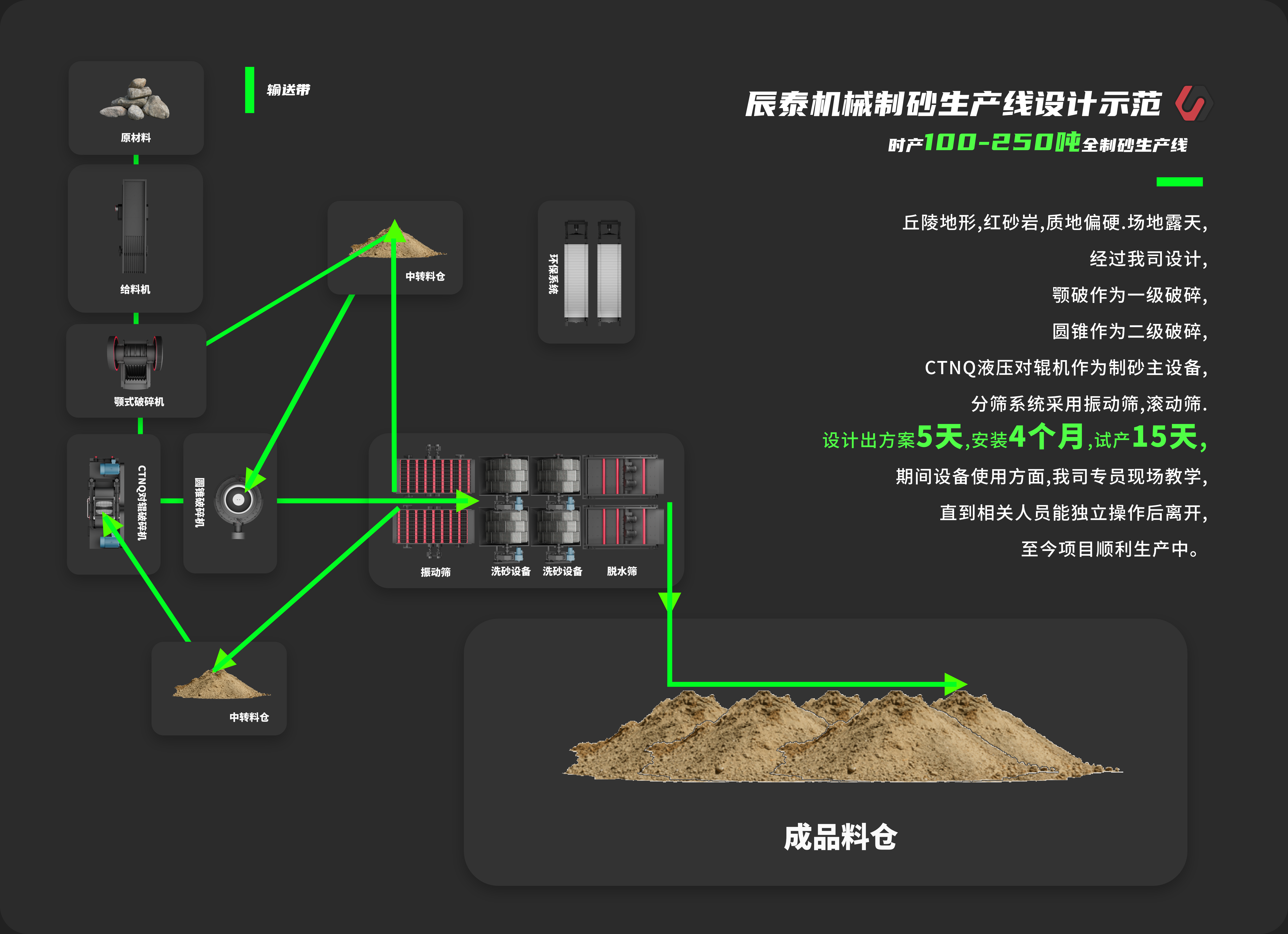
In order to feed the stones to the machine, a feeder is needed.
In order to turn large stones into medium stones, a jaw crusher is needed to bite the 600mm-300mm stones and then send them to the warehouse for transfer.
In order to turn the middle stone into a small stone, a cone crusher is needed to turn the 500M medium stone into a small stone about 30mm through the movement of the large central cone.
In order to turn small stones into sand, an automatic hydraulic roller crusher is needed to rotate inward through the double roller cylinders to turn 30mm small stones into sand below 5mm.
Flowchart.png
Since a large amount of stone will become a fish that leaks through the 3-layer screen on the vibrating screen, the large stones are returned to the cone, and the small stones are returned to the roller machine to send the formed sand to the next station.
Fresh sand is often mixed with soil and impurities, and it must be washed before use, so a sand washing machine is needed. After washing, it is also necessary to dehydrate and dehydrate the sand before it can be dried, so it is necessary to have a dehydration screen.
The dehydrated sand will be sent to different areas for storage according to the particle shape. The clean water used in the process will be sent to the filter press after washing the sand. By extrusion and filtering, the mud impurities in the water will be turned into soil blocks, and then recycled to the clean water pool for repeated use.
What is mentioned above is a complete wet sand making line.